Iconic sheep in NZ. See more videos I took in NZ here
Showing posts with label Tracy. Show all posts
Showing posts with label Tracy. Show all posts
Monday, August 23, 2010

Wednesday, August 18, 2010
Day 2 NZ - Arataki Honey Center

I awoke this morning at 9, having had the best night's sleep since I left home. After about an hour of puttering around I drove out to Havelock North, passing numerous vineyards, orchards, and fields filled with fluffy sheep greedily tearing up the luscious green turf. I caught sight of the pacific. It shone iridescent-blue, lapping gently against the grey pebbled shore.
On my agenda today is a visit to the Arataki Honey Center, one of the largest beekeeping operations in NZ. As I drove through the lovely countryside I ached to be outside rather than tied to meetings and schedules. However, the Arataki Honey Center did not disappoint. After being shown around their fun and very educational honeybee learning center, I sat down with John, their beekeeping manager and chatted about small hive beetle and beekeeping in NZ.
I learned a lot of interesting stuff about kiwifruit. Did you know that they are dioecious plants (male and female flowers are on separate plants)? Did you know that they only have viable flowers for 4-5 days? That the flowers do not provide nectar? That the pollen is nutritionally poor? Did you know that it takes 70-80 honeybee visits per flower to get full-sized fruit? Basically, it's one of the hardest plants in the world to pollinate. Kiwifruit growers have done everything they can to make pollination happen. They saturate the orchards with bees for the 4-5 days that they are in flower. They hand-harvest male flowers and spray the pollen over the orchards and the bees.
I also learned a lot about New Zealand's miracle honey plant - Manuka. Apparently they still don't really know what makes one batch of Manuka highly antimicrobial and the next batch not as antimicrobial. Each batch has to be tested as it comes in and after it is packaged before it can be certified antimicrobial. Activity seems to increase with storage up until a certain point. The honey produced from Manuka can be light or dark, and it always darkens with age.
I had the best honey in my life at the taste-testing center. It's called Pohutukawa (poe-HOOT-uh-kaw-uh). Fill a chocolate truffle with creamed Pohutukawa honey and I'd subsist on that alone for the rest of my life if necessary.
I learned that there is poisonous honey in New Zealand. It's made from the honeydew of a vine-hopper feeding on the Tutu plant. So now every batch of honey in NZ has to be tested for the neurotoxin called Tutin. It has caused many beekeepers to cease production of comb honey since you have to be able to show that each individual cell of honey is Tutin-free to be able to legally sell the comb honey.
 After Arataki, I went into Havelock North to have some lunch, then decided to visit Te Mata peak. It was a scary drive all the way up to the top in my little car, but I and all the drivers, mountain bikers, and hikers that I met on the way survived. I was rewarded with another view of the pacific, of Napier, Hastings, and Havelock North, and of the surrounding country. My Elvish eyes spotted mostly sheep.
Descending from Te Mata, I drove into Hastings and visited the grocery store. A woman was offering wine samples in the aisle. There are so many wineries in this place they're practically pouring the stuff down your throat at every turn. I found a yarn store offering me a selection of yarn from NZ sheep and a "bin shop" offering me everything from almonds to window cleaner in bulk. The place definitely has the feeling of a popular holiday-spot on the off season. Ice cream parlors and posh cafes stand open but few patrons enter. The only other people walking around are the Kiwi school-kids wearing their regrettable school uniforms and fancy purses that play music. Why you would want a purse that plays music, I wonder?
I returned home to my luxury accommodations, greeted by a calico cat and a brand new television. As I ate two kiwifruit, I thought about the 140-160 times that a bee touched a flower to bring me my dinner.
For my NZ pictures, see the new Picasa Album here
Onward to NZ
 Our stay in Australia over, I have traveled to New Zealand. How can I describe it? It's a land that I would like to marry and settle down with, filling the rest of my days exploring all the little sheep-dotted hillsides, pebbly beaches, and rich green mountains.
I haven't even really been here very long. I spent the first night here in a cheap motel in Auckland run by an Indian family. They were lovely and it was reasonable for the price, but it was definitely not a place that inspired rest. Early the next morning a shuttle driven by a woman named Ngaia took me to Hamilton and I disgraced myself by falling asleep. Fortunately, I am both a discreet and fetching sleeper. I was deposited at the AsureQuality office and met with Byron and chatted a bit over some needed coffee. Drip coffee this time. Kiwis apparently aren't as picky about their coffee as the Aussies. We drove over to the Plant and Food Research Apicultural division and I met Byron's wife Michelle who works on varroa-resistant bees and her boss Mark who gave me his opinion on everything bee-related and un-bee-related, particularly Australia, USA, and why New Zealand is superior to those countries.
I had almost run out of brain power by the time we got back to AsureQuality. I was ready to go to bed, but I still had a 4 hour drive to Napier ahead of me. Byron kindly drove me to the Airport to pick up my car and reminded me about the unique Kiwi road rules such as no left on red and yield to oncoming right-turners when you're taking a left. They love the roundabout in this country, too. Every intersection spins you like a merry-go-round, exits shooting off the center circle like so many bicycle-wheel spokes.
I got on the road by 4pm, driving an exceedingly cheap Australian-made car. I found out that the kiwi definition of "highway" apparently is "lonely two-lane track through nowhere." So strange to drive so far without the comforting presence of other drivers. I guess that’s what I feel like I’m doing here- striking out on my own despite the fact that I don’t really know anyone in this country, don’t know if I can get a job in this country, don’t know where I’m going in this country on this little highway in the dark. No one driving my way to encourage me, to say, “Yup, you’re going the right way!” Strange stars hang in the sky as I stop to take a look around in the dark. They are useless to navigate by. But I see a shooting star, and think, with a sigh, that it’s not a bad road that I’m on anyway.
I arrive after some delay finding my hotel in Napier. The hotel manager offers me "trim milk" and a newspaper. Then he has me park my car in a tiny little spot on the corner of the hotel. He crosses my own personal courtyard and opens big French windows to a small efficiency apartment, complete with mini-range, mini-fridge, mini-bar with mini-stools, mini-sink, mini-cupboards, mini-microwave, mini-tv, etc. He stashes the milk in the fridge for me and bids me goodnight. Everything in my room is tastefully selected from Ikea. Clean, simple, warmly well-lit. I open the door to the bathroom and I am greeted by a large, lavatorial refuge, soothing colors, a new shower, and multiple mirrors. There are premium soaps. There is an abundance of nice towels. I am in heaven. Then I walk out and notice that there is something hanging from the side of the bed. The controls for my electric blanket. How far did I have to come for this? It doesn’t matter.
Wednesday, August 4, 2010
Introductions: Tracy
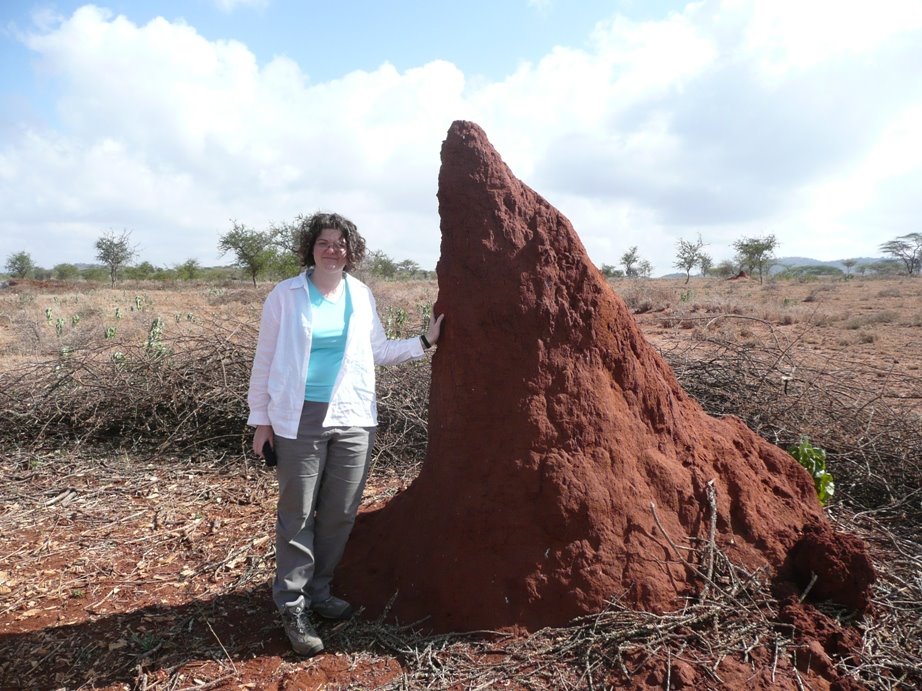
Hi all, I’m Tracy! I am a 4th year graduate student in Entomology at Penn State. I’ve been involved with Penn State Christian Grads since I moved here from the warm wonderland known as Florida. I study bees, beetles, yeast, and pollen. I like MacGyver and I live with student of cosmic mysteries and member of the A-team.
I’m going to Australia because I like going places, but also because I have a strong conviction that grad students are a truly unique group of people with emotional and spiritual needs which might be considered a bit strange by “normal” folks. Take for instance, a common problem among grad students known as the Imposter Syndrome. This mental deformity causes very bright, very accomplished students to think to themselves “I don’t belong here. I’m not actually smart, I’ve only gotten this far by chance.” There is a deep fear of being unmasked, of someone finally finding out that they aren’t actually mensa candidates1. I’ve felt like this at various points in my graduate career, as have most other grad students I’ve encountered. The focus is on our performance – about keeping it together. With God, the focus is on grace – extravagant grace, in which each of us is completely known and completely loved despite our performance or lack thereof. It’s a beautiful message for tired grad students, or anyone who is weary of wearing a mask.
Another thing I enjoy about being in graduate student ministry is discovering the endless diversity of geeks out there. Everyone in grad school is really into some specific area of study. Ask them about it, and you will be treated to a beautiful lecture, enthusiastically delivered as if you were discussing the only truly interesting topic known to man. After your initial lecture, if your eyes have not become too unfocused, the graduate student will treat you as one of them. You now belong to a secret society of those that know just what is so absorbing about their particular topic. Sometimes I am at a loss to understand such erudite and diverse topics as neurophysics, glaciers, computer security, atmospheric chemistry, Abelard, and cosmic rays. But I am delighted to have friends who “geek out” on me when one of these topics is mentioned. Grad students are unapologetic specialists. In their specialties, I see that God has given each of us gifts, talents, and interests unlike those of any other person. In some cases, very unlike those of any other person. C.S. Lewis puts it nicely when he says “…each of the redeemed shall forever know and praise some aspect of the divine beauty better than any other creature can. Why else were individuals created, but that God, loving all infinitely, should love each differently?”2
So my best hope for this trip is to see a few more imposters ditch their masks and plant flags on their own particular corner of geekdom. The world’s got enough perfect, normal people.
1. Laursen, Lucas. 2008. No, you're not an imposter. Science Careers.
2. Lewis, C.S. The Problem of Pain. New York: Macmillan, 1962.
Subscribe to:
Posts (Atom)