Yesterday we had a great day going out East of Melbourne to Marysville and Healesville. Our intrepid Aussie expert, Jared, drove us out of the city traffic and into a country populated by sheep and horses still shaggy with winter and endless vineyards, their closely pruned vines stretching in parallel lines over the hills. We passed so many vineyards, I wondered if they ever ran out of pretentious-sounding surnames to call them by. Climbing further, we encountered gum tree forests carpeted with soft green ferns. Large tree ferns filled the understory like palm trees, their armored, reptillian stems making us feel as if a velociraptor might pop out into the road at any moment. The bark peeled from the gum trees like they were giant brown string cheese sticks.
 Further on, we crossed into a different sort of forest. This was the area where in 2009, brush fires had raged through, killing 173 people and destroying whole towns like Marysville. We pulled into Marysville, new houses everywhere, and marveled at how much they had rebuilt in a year. The forests are recovering curiously, the gum trees covered in a furry layer of new growth.
 We turned around and hit Healesville, where we stopped at a bakery and had pies, a very traditional Australian treat like a pot pie but with lots of different options for fillings. Good Aussies like Jared squirt tomato sauce (ketchup) on theirs. There were also a large variety of sweets. I picked one at random off the menu- a "beesting." Jared had something called a lambington, which, as he promised, contained no lamb.
After lunch, we headed for the Healesville wildlife sanctuary where we got to meet all the most popular Australian animals: kangaroos, emus, koalas, wombats, platypus, tasmanian devils, snakes, echidna, dingoes, and numerous birds. Among the birds, we were especially privileged to see and hear a lyrebird singing. There are videos and pictures better than mine, so be patient, they will soon be coming to a picasa album near you. In the lyrebird enclosure we met a delightful sanctuary volunteer named Leigh, who also showed us the secret nest of an eastern yellow robin in the bushes.
 Running out of time now, Leigh implored us to visit the dingo puppies instead of running off to make it to the footy match. I could have lived there all day, but, alas, Jared's friend Paul was waiting for us. Perhaps we will have time to hit up the zoo later.
The footy match merits a post all to its own, so I won't get into it right now. Suffice to say I stumbled home around midnight, incredibly tired after such a full day!
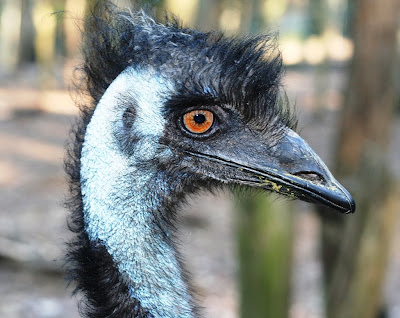
In junior high I was a member of an agricultural youth organization known as 4-H. I'm not exactly sure, but I think that the four H's of 4-H meant Head, Heart, Hands, and Huge Flightless Birds. You see, my 4-H club pioneered the area of 4-H emu husbandry. For two years, I learned how to raise emus from chicks- feed them, catch them, sex them, vaccinate them, show them, and sell them. (They may look like dinosaurs, but they taste like top sirloin.) I came to love their musical booming and drumming, their dark chestnut eyes, their black curls, blue skin, and smooth, brown bifurcated feathers. They were to me like lovely exotic parrots but taller and better at running.
The nation of Australia has had a love-hate relationship with their most common native Ratite. Emus proliferate all over Australia, and sometimes they trample and eat crops. In 1932 Western Australia declared war on emus, sending men with machine guns after them. The emus won. As Australian ornithologist D. L. Serventy recorded: "The machine-gunners' dreams of point blank fire into serried masses of Emus were soon dissipated. The Emu command had evidently ordered guerrilla tactics, and its unwieldy army soon split up into innumerable small units that made use of the military equipment uneconomic. A crestfallen field force therefore withdrew from the combat area after about a month." Despite the tendency of irritated farmers to occasionally shoot them, emus are now, for the most part, considered important members of Australian fauna. They are now protected by law and (unofficially) the national bird of Australia.

The thing I always rather liked about the emus was their innate curiosity. Standing still for a minute in the emu enclosure rewarded you with an entire flock (or is it herd?) of emus all eager to sample your hair, your clothes, and your shoelaces as they might chance to be edible. I guess when you are nearly six feet tall and armed with six vicious claws on the end of two powerful reptilian legs, you don't expect anyone to be foolish enough to cross you. Or perhaps they are just friendly. Cast down from the skies where their bird brethren soar, emus accept that they will always be forsaken oddities and must make friends where they can. Even if those friends include someone like a gawky teenage girl with a disturbing habit of wearing flannel.
Top photo by flickr user OZinOH licensed under Creative Commons Attribution-NonCommercial 2.0 Generic license.
 Further on, we crossed into a different sort of forest. This was the area where in 2009, brush fires had raged through, killing 173 people and destroying whole towns like Marysville. We pulled into Marysville, new houses everywhere, and marveled at how much they had rebuilt in a year. The forests are recovering curiously, the gum trees covered in a furry layer of new growth.
 We turned around and hit Healesville, where we stopped at a bakery and had pies, a very traditional Australian treat like a pot pie but with lots of different options for fillings. Good Aussies like Jared squirt tomato sauce (ketchup) on theirs. There were also a large variety of sweets. I picked one at random off the menu- a "beesting." Jared had something called a lambington, which, as he promised, contained no lamb.
 Running out of time now, Leigh implored us to visit the dingo puppies instead of running off to make it to the footy match. I could have lived there all day, but, alas, Jared's friend Paul was waiting for us. Perhaps we will have time to hit up the zoo later.


